Is the Methane Catastrophe Happening Right Now?
The primary sink for methane is a reaction with the highly reactive and very short-lived hydroxyl radical, OH*. Once created, OH* looks for something to react with, and typically finds it within about a nanosecond (1 billionth of a second). About 90% of all methane is removed from the atmosphere by a reaction with a hydroxyl radical.
There are other chemicals entering the atmosphere that are preferentially reacting with hydroxyl radicals, using them up before they have a chance to react with methane. The main culprit is carbon monoxide (CO), which is about 40 times as reactive with hydroxyl radicals as methane, giving CO a half-life of about 3 months.
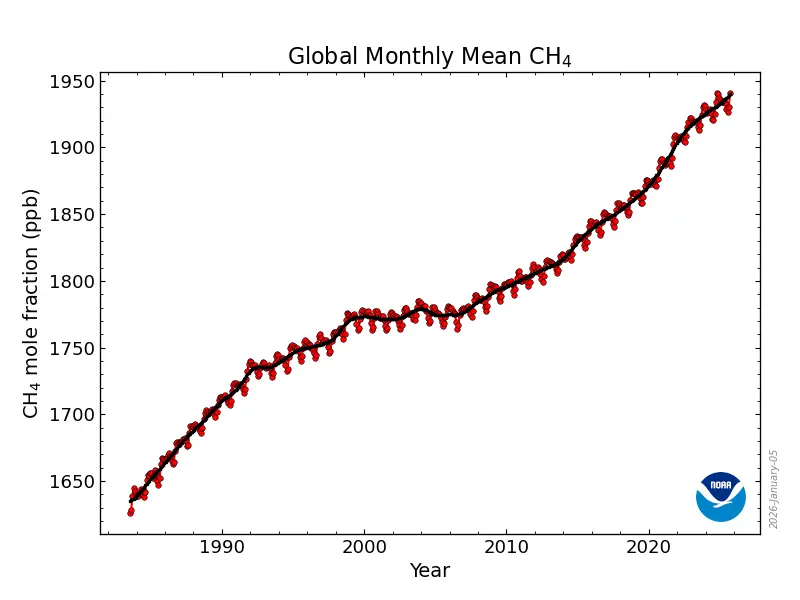
So here’s the feedback loop: global warming is driving wildfires, those fires are releasing carbon monoxide into the atmosphere, that carbon monoxide is cannibalizing the hydroxyl radicals that would normally oxidize methane, the methane in the atmosphere is lasting longer than before, longer lasting methane means a spike in global methane exactly as NOAA is reporting, and finally, the spike in methane is increasing the heating of the planet, driving more global warming.
Highlights
-
Hydroxyl radicals will preferentially react with CO over methane
Wildfires lead directly to increased methane in the atomsphere -
Hydroxyl radicals will preferentially react with H₂ over methane
So a hydrogen based economy would be as bad as a fossil fuel based economy -
"Saturation of the hydroxyl sink is the worst case scenario.”
If enough methane has entered the atmosphere through natural and anthropogenic sources, there is a very real possibility that methane has simply overwhelmed the available hydroxyl -
Methane is increasing at record rates
Compared with 2019, measurements of the global growth rate of background (marine air) atmospheric methane rose by 5.3 ppb yr−1 in 2020, reaching 15.0 ppb yr−1.